
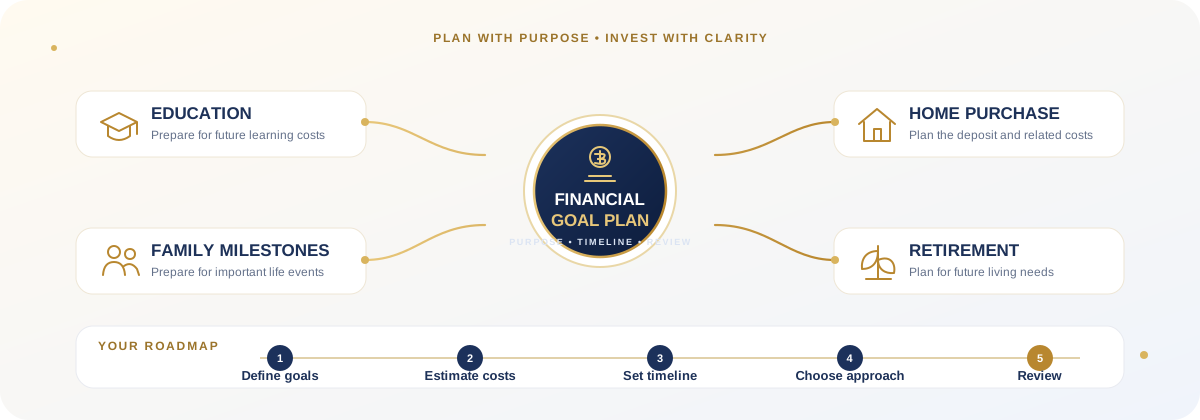
Most important financial milestones do not happen overnight. A child’s education, buying a home, starting a business, or preparing for retirement may require years of preparation. Financial goal planning helps connect these life priorities with a practical savings and investment plan.
Instead of choosing an investment first and deciding what to do with the money later, begin by asking: What do I need the money for, when will I need it, and how much might I require?
1. Identify your financial goals
Write down the financial milestones that matter to you and your family. Be specific about the purpose rather than using a general target such as “build wealth”.
- Education: funding school, college, or professional studies.
- Home purchase: building a down payment or preparing for related costs.
- Family milestones: planning for marriage or other major expenses.
- Retirement: preparing for future living expenses and healthcare needs.
- Financial security: maintaining emergency savings and adequate protection against unexpected events.
2. Estimate how much the goal may cost
Start with an estimate of today’s cost, then consider how prices may change before you need the money. Education, healthcare, housing, and other expenses may rise at different rates. An inflation assumption is only a planning input, not a prediction.
Illustrative inflation example
If an expense costs ₹25 lakh today and rises at an assumed 6% per year, its estimated cost after 15 years would be about ₹60 lakh. This is a mathematical illustration, not a forecast; actual inflation and future costs may be higher or lower.
3. Set a realistic time horizon
The time remaining before a goal is due affects how much you may need to save, how much uncertainty you can reasonably accept, and how much flexibility you have if markets or personal circumstances change.
- Short-term goals: money may be needed soon, so capital stability and liquidity can be important priorities.
- Medium-term goals: consider the goal date, the impact of possible losses, and the need to reduce risk as the date approaches.
- Long-term goals: a longer horizon may allow consideration of growth-oriented investments, but market risk and potential losses remain.
4. Match the investment approach to the goal
Investment selection should follow the goal, not the other way around. Consider the time available, risk tolerance, liquidity requirements, existing investments, and your ability to withstand losses. Market-linked investments can fluctuate in value, and returns are not guaranteed.
A long-term goal does not automatically make every high-risk investment suitable. Similarly, money required for a near-term expense may need a different approach from money intended for a distant retirement goal. Review the suitability of each investment in the context of your overall financial situation.
5. Turn the goal into a savings plan
Once you have a target amount and timeline, estimate how much you can set aside regularly. A calculator can help explore different contribution amounts and hypothetical return assumptions. The results are estimates and should not be treated as guaranteed outcomes.
- Record the target amount and expected date.
- Review current savings and investments already earmarked for the goal.
- Estimate the remaining amount to be funded.
- Choose a contribution schedule that fits your cash flow.
- Keep emergency savings separate from money committed to long-term goals.
6. Protect the plan from unexpected events
A goal plan should account for more than investment returns. Emergency savings, suitable insurance cover, manageable debt, and a realistic household budget can help reduce the chance that an unexpected expense derails your progress.
7. Review progress and adjust when needed
Review your plan periodically and when a major life event changes your income, expenses, family needs, or target date. Compare actual progress with the plan, reassess assumptions, and consider whether the contribution amount or investment mix needs adjustment. Avoid making changes solely in reaction to short-term market movements.
Common financial goal planning mistakes
- Setting a target without estimating the future cost.
- Ignoring inflation and unexpected expenses.
- Using the same investment approach for every goal.
- Assuming a particular rate of return is certain.
- Investing money needed soon without considering potential losses or liquidity.
- Failing to review the plan when circumstances change.
Make your goals the starting point
Financial goal planning gives your money a clear purpose. By defining milestones, estimating future costs, choosing a realistic timeline, and reviewing progress, you can make more structured financial decisions. The right plan is personal: it should reflect your priorities, financial circumstances, and capacity to accept risk.
Important information
This article is for general educational purposes only and is not a guarantee of investment performance or a recommendation to buy or sell any particular investment. Mutual fund investments are subject to market risks. Please read all scheme-related documents carefully and consider your financial circumstances and risk profile before investing.